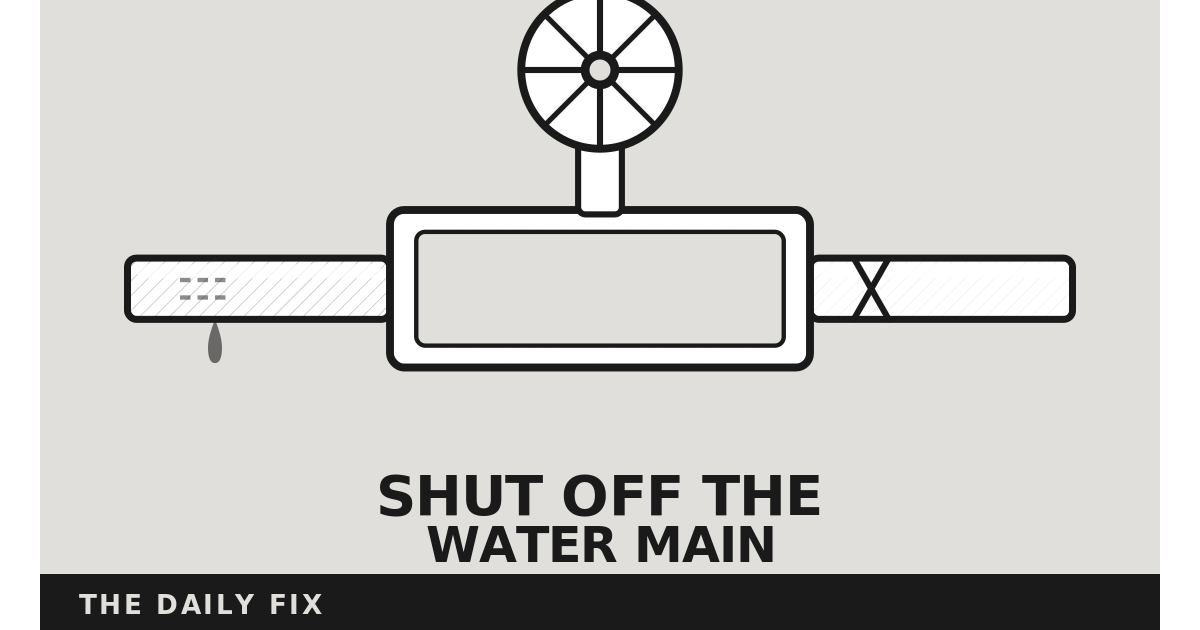
How to Shut Off Your Water in an Emergency (Find It Before You Need It)
A toilet overflows. A pipe bursts. Water is coming through a light fixture in the ceiling. In any of these situations, the first thing to do is the same: shut off the water. Most renters have no idea where to do that, and in an emergency that ignorance gets expensive. Every apartment has shutoffs at two levels — individual fixture shutoffs for one specific thing (a toilet, a sink, a washing machine), and a main unit shutoff for everything at once. Knowing where both are, and confirming they work, is a five-minute task that can prevent thousands of dollars in water damage.
Individual fixture shutoffs
Every toilet has a shutoff valve behind and below the tank — a small oval or football-shaped knob on a braided metal hose. Turn it clockwise to close it, and confirm right now that it actually turns; if it’s seized, tell your landlord before you need it. Under every sink there are two valves on the supply lines — hot and cold — same principle. Washing machines have hot and cold valves on the wall behind them too.
Step 1: Find your main unit shutoff
It’s usually in one of five spots: the utility closet (often on the cold line into the water heater), under the kitchen sink, behind a small access panel in a hallway or bathroom wall, in a shared basement or utility room in multi-story buildings, or in an access box near the entrance of some ground-floor units. Ask your landlord if you can’t find yours.
Step 2: Confirm it works
Turn it — clockwise closes, counterclockwise opens; a lever-style valve closes when rotated perpendicular to the pipe. You don’t need to fully shut it off to test, just confirm it moves freely. A valve that won’t budge is a maintenance issue — report it before you need it.
Step 3: Know your building’s main shutoff
For larger emergencies — a burst pipe inside a wall, water from the unit above — the building’s main shutoff may be needed. Ask your landlord now where it is and who has access, and save an emergency contact number in your phone under something you’ll actually search for at 2am.
Step 4: Document the locations
Take a photo or a phone note of every shutoff — main, toilets, sinks. Thirty seconds now means zero time searching during an actual emergency.
Mistakes to avoid
- Assuming you’ll find it during the emergency. Emergencies are stressful and disorienting — know the location beforehand.
- Not checking that the valve actually turns. A shutoff that’s seized in place is worse than not knowing where it is.
Find your individual fixture shutoffs, find your main unit shutoff and confirm it turns, and save the building emergency contact in your phone. Five minutes of prep that matters enormously the one time you need it.
Related Posts
How to Build a Basic Apartment Emergency Kit (Under $75, One Afternoon)
A basic apartment emergency kit costs under $75 and takes one afternoon to build. Here's exactly what to get and why each item matters.
How to Replace a Smoke Detector Battery (And When to Replace the Whole Unit)
That chirp every 60 seconds means one specific thing: a low battery. Here's the 30-second fix, plus the one thing to check while you're up there.
What to Do When Your Circuit Breaker Trips
A tripped breaker won't reset if you skip one step. Here's the exact sequence to fix it — and what it means if it trips again right away.