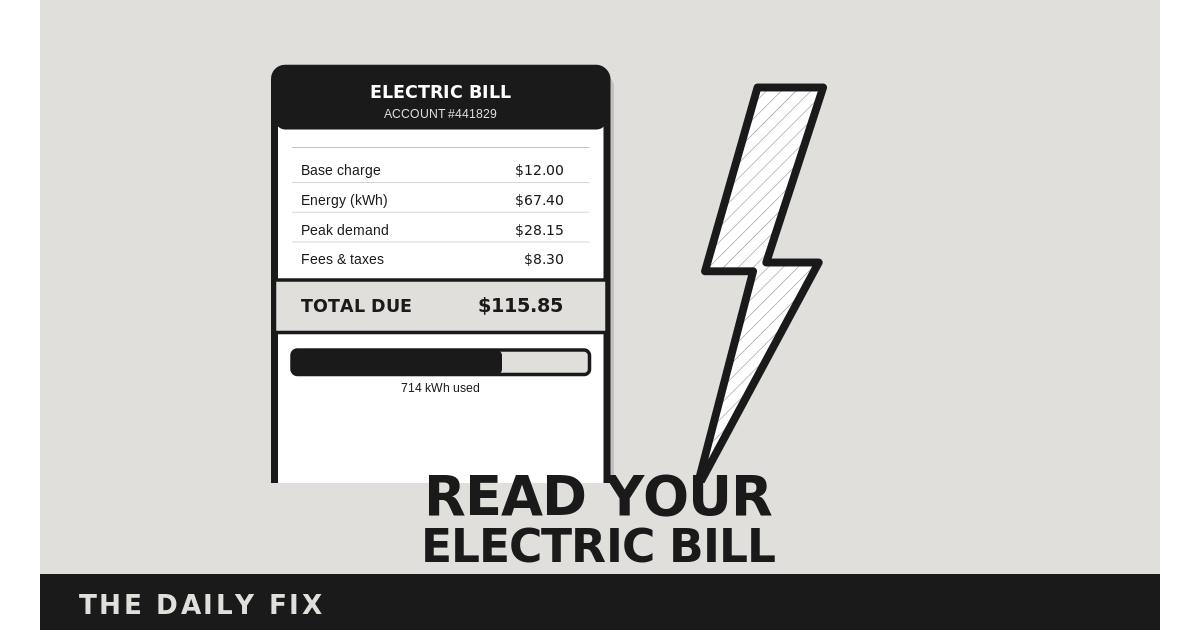
How to Read Your Electric Bill (And Find Where You're Wasting Money)
Most renters pay their electric bill every month without understanding a single line on it — they pay whatever it says and move on. That habit costs the average renter $20 to $40 a month in preventable waste. Electric bills aren’t designed to be easy to read, but there are only four things you actually need to understand to use yours as a tool.
The four things to understand
Kilowatt-hours (kWh) are the actual unit of energy you’re buying — a 100-watt bulb running 10 hours uses one kWh. This is the most important number on your bill. Your rate is what you pay per kWh — the national average runs 12–16 cents, though it varies by region. Multiply usage by rate and you’ll land near your bill total; the rest is fees and taxes. Delivery vs. supply charges split the bill into the electricity itself (supply) and the infrastructure that delivers it (delivery, which is fixed regardless of usage) — your conservation efforts only affect supply. Usage history, usually a 12-month bar chart, shows spikes that tell you exactly what happened — a hot summer month, a new work-from-home routine, a new gaming console.
Finding where you’re wasting money
Look at your two or three highest-usage months and think about what was different. The three biggest draws in most apartments are heating and cooling (45–50% of use — check if your spikes track summer AC or winter heat), phantom load from devices left plugged in and idle (5–10% of the average bill), and water heating, the typical second-largest draw if yours is electric.
Step 1: Identify your highest-usage months and the cause
Use the history chart to spot the pattern before changing anything.
Step 2: Swap incandescent bulbs for LEDs
LEDs use 75% less energy for the same output. A 10-pack costs about $15 and pays for itself within two months of replacing incandescents.
Step 3: Use a smart power strip
Plug your TV, console, and entertainment devices into one that cuts standby power when the main device is off — $20–$30, saving $5–$15/month depending on your setup.
Step 4: Check for time-of-use pricing
If your utility offers lower off-peak rates, run the dishwasher and laundry at night. Check your bill or utility website to see if it applies to your plan.
Step 5: Adjust your thermostat
Every degree you lower the heat or raise the AC cuts HVAC consumption by roughly 3%. A programmable thermostat that adjusts while you sleep and before you wake does this automatically.
Mistakes to avoid
- Ignoring the usage history graph. It’s the one tool that makes your bill actionable instead of just a charge to pay.
- Focusing only on lights. Lighting is a small fraction of most apartments’ usage — HVAC, standby power, and appliance habits matter far more.
Find your kWh usage, understand your rate, separate what you control from what you don’t, and check your usage history monthly. Swap to LEDs, use a smart power strip, and adjust your thermostat — the changes that actually move the needle.
Products mentioned in this post
Some links above are affiliate links. We may earn a commission at no extra cost to you.
Related Posts

Renter's Insurance Explained (What It Covers, What It Costs, How to Get It)
For about $12 a month, renter's insurance covers what your landlord's policy doesn't: your stuff. Here's what it covers and how to get it in 15 minutes.

How to Read Your Lease Before You Sign (8 Things That Matter Most)
Most renters sign a 12-month contract without reading it. Here are the eight clauses that actually determine what happens during your tenancy.

How to Get Your Security Deposit Back
Landlords keep more of your deposit than they should when you don't know the rules. Here's how to get every dollar back.