
Renter's Insurance Explained (What It Covers, What It Costs, How to Get It)
Here’s what most renters don’t understand: your landlord’s insurance covers the building, not anything inside your apartment. If a pipe bursts in the unit above and ruins your furniture, laptop, and TV, that loss is yours unless you have renter’s insurance — which runs about $12 to $15 a month. Unlike health or auto insurance, claims here are usually straightforward because the covered events are concrete: fire, theft, water damage, vandalism.
What it actually covers
Personal property — your belongings, up to a limit you choose, if they’re stolen or destroyed by a covered event. Personal liability — if a guest is injured in your apartment and sues you, the policy covers legal defense and settlements, typically up to $100,000. Additional living expenses — if a covered event makes your apartment uninhabitable, the policy pays for a hotel and meals while you’re displaced. It does not cover floods from outside (that needs separate flood insurance), earthquakes, or normal wear and tear.
Step 1: Inventory your belongings
Walk through your apartment and roughly catalog what you own — the easiest method is photographing or filming every room. It gives you a coverage estimate and documentation you’ll need for any future claim. Most renters are surprised to find they own $15,000–$30,000 in personal property once they actually add it up.
Step 2: Understand the two coverage types
Actual cash value pays what your item is worth today, depreciated — a three-year-old $1,000 laptop might only get you $200. Replacement cost pays what it costs to buy an equivalent new item, so that same laptop gets you $1,000. Replacement cost costs slightly more per month but pays off significantly more if you ever file a claim — choose it.
Step 3: Get quotes from multiple providers
Get two or three quotes from providers like Lemonade, State Farm, Allstate, or Progressive. Lemonade is app-based and typically $5–$15/month; traditional insurers offer more personalized service and bundle discounts with auto insurance. Compare both the premium and the deductible — a lower premium often means a higher deductible.
Step 4: Choose your coverage amount and deductible
Set personal property coverage based on your inventory, rounding up — a $20,000 policy with a $500 deductible typically runs $12–$18/month. For liability, $100,000 is standard; consider $300,000 if you host guests often or have a dog, since the cost difference is minimal.
Step 5: Set up the policy
Complete the application online with your address, household size, and whether you have pets, then set up payment by card or bank draft — you’ll get a policy document by email within minutes. Save the policy number somewhere accessible; some landlords require proof of coverage before move-in.
Mistakes to avoid
- Underinsuring to save a couple dollars a month, then discovering you’re only covered for half of what you lost.
- Choosing actual cash value to save money. The premium difference is usually $2–$5/month; the claim payout difference can be thousands.
Inventory your belongings, choose replacement cost coverage, get quotes from two providers, and set up autopay — the whole process takes about 15 minutes online.
Related Posts
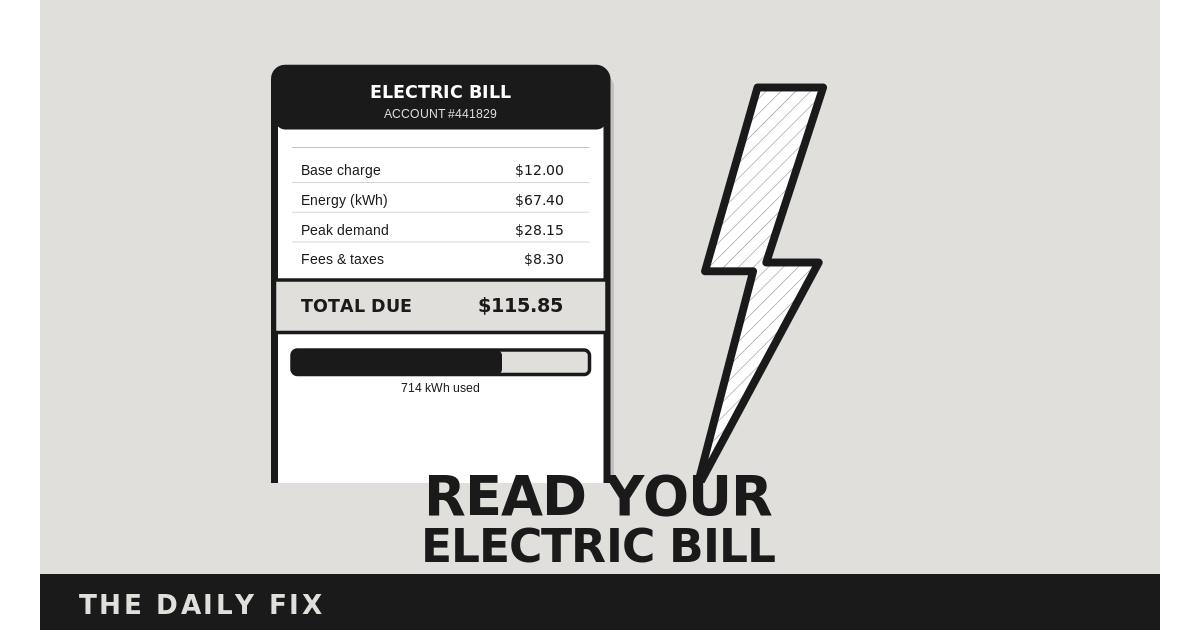
How to Read Your Electric Bill (And Find Where You're Wasting Money)
Understanding four numbers on your electric bill can save you $20 to $40 a month. Here's how to read it and find where you're wasting money.
How to Read Your Lease Before You Sign (8 Things That Matter Most)
Most renters sign a 12-month contract without reading it. Here are the eight clauses that actually determine what happens during your tenancy.
How to Get Your Security Deposit Back
Landlords keep more of your deposit than they should when you don't know the rules. Here's how to get every dollar back.